Cost Segregation for Warehouses & Distribution Centers: 2026 Guide
A warehouse is mostly 39-year shell — until you look at the lot. The truck court, trailer parking, and yard scale with site area, not building size, so a big lot is the whole story. A $6.4M distribution center on a 3× lot reclassifies ~$1.2M (≈23%), about $465,000 in Year-1 federal tax savings.
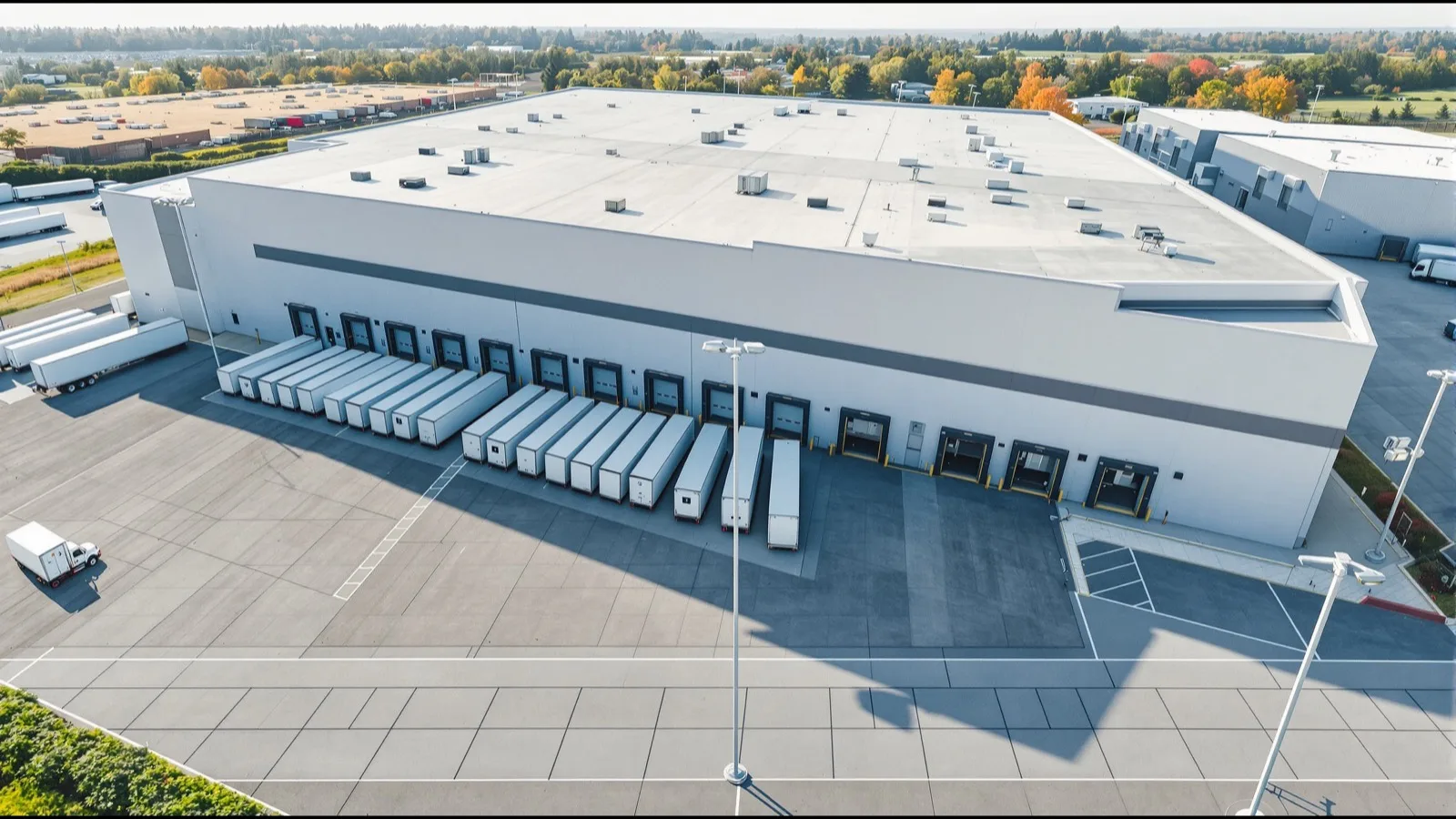
A warehouse is mostly 39-year shell — until you look at the lot. The truck court, trailer parking, and yard scale with site area, not building size, so a big lot is the whole story. A $6.4M distribution center on a 3× lot reclassifies ~$1.2M (≈23%), about $465,000 in Year-1 federal tax savings.
A warehouse looks like a bad cost-segregation candidate — and then you look at the lot. A distribution building is mostly 39-year shell: a big steel structure, a roof, and a slab, with relatively little of the decorative or specialty property that makes a restaurant or medical office reclassify so heavily. But a warehouse doesn’t sit on a small lot. It sits on a massive paved truck court, trailer yard, and parking — often two to four times the building footprint — and that paving is 15-year land-improvement property. Add the dock equipment, high-bay LED, and material-handling infrastructure (5-year), and the owned racking (7-year, when documented), and a shell-heavy building turns into a real study. On a $6.4 million distribution center on a 3× lot, about $1.2 million (≈23%) of basis reclassifies — worth roughly $465,000 in Year-1 federal tax savings at the 37% bracket with 100% bonus depreciation, against a study fee around $7,995. A study identifies and documents those assets; it does not assume them.
The Lever Is the Lot — “Square-Footage Leverage”
Most property types tell a building story. A warehouse tells a site story. Because site work scales with the lot, not the building, the same 60,000 SF building reclassifies very differently depending on how much paved yard surrounds it.
The yard (lot-scaled). Heavy-duty reinforced truck-court paving is the dominant line in a distribution study — it’s engineered for loaded trailers, it’s expensive per square foot, and there’s a lot of it. Add trailer-storage paving, auto parking, tall pole lighting over the yard, site drainage and detention, the underground yard fire loop and hydrants, and perimeter fencing, gates, and bollards. All of it is 15-year land improvement, and our model scales the truck-court line to your actual lot or truck-court size. A building on a 4× lot reclassifies meaningfully more than the same building on a tight pad.
The dock and the equipment. Dock levelers, seals, shelters, bumpers, and restraints; material-handling rough-ins and forklift charging; high-bay LED fixtures and controls; warehouse-management low-voltage and yard security — all 5-year personal property. Owned pallet racking and mezzanines are 7-year property when you own them and document them.
What a cost segregation study changes.
| Metric | Without cost seg (39-year) | With cost seg + 100% bonus |
|---|---|---|
| Year-1 depreciation | ~$135,000 | ~$1,257,000 |
| Year-1 tax savings @ 37% | ~$50,000 | ~$465,000 |
| Reclassified into 5/7/15-yr | $0 | ~$1,200,000 (≈23%) |
| Study cost | N/A | ~$7,995 |
| Delivery time | N/A | Under 1 hour |
What Gets Reclassified
Our engine models a warehouse from a dedicated component library built bottom-up from industry-standard construction cost data (GSA schedules, public procurement pricing, DOT unit-cost data). Here’s what moves out of the 39-year shell.
Fifteen-year land improvements — the yard (lot-scaled):
- Truck-court paving (heavy-duty reinforced concrete — the dominant line), trailer-storage & auto parking, heavy pole / yard lighting, site drainage & detention, yard fire loop, hydrants & yard fire pump, perimeter fencing, gates, bollards & guard booth, monument signage
Five- and seven-year property — dock, equipment & racking:
- Dock equipment (levelers, seals, shelters, bumpers, restraints), material-handling infrastructure (conveyor rough-ins, charging), high-bay LED & controls, warehouse-management low-voltage & yard security, office-mezzanine FF&E — all 5-year
- Owned pallet racking & storage mezzanines — 7-year, when owned and documented
Here’s how the most common distribution-center assets typically classify:
| Component | Typical recovery period |
|---|---|
| Truck-court paving (heavy reinforced concrete) | 15-year — scales with lot size |
| Trailer-storage & auto-parking paving | 15-year land improvement |
| Heavy pole / yard lighting | 15-year land improvement |
| Site drainage & detention | 15-year land improvement |
| Yard fire loop, hydrants & yard fire pump | 15-year land improvement |
| Perimeter fencing, gates, bollards & guard booth | 15-year land improvement |
| Dock equipment (levelers, seals, shelters, restraints) | 5-year personal property |
| Material-handling infrastructure & charging | 5-year personal property |
| High-bay LED fixtures & lighting controls | 5-year personal property |
| Warehouse-management low-voltage & yard security | 5-year personal property |
| Owned pallet racking & mezzanines (documented) | 7-year personal property |
| Interior ESFR sprinklers, clear-height structure & shell | 39-year real property |
Recovery periods reflect typical treatment under IRS Publication 5653 and Rev. Proc. 87-56. The classification of any specific asset depends on its facts and is determined in the study — and equipment and racking are included only when owned and documented, never assumed. Interior ESFR sprinklers and the structural shell stay on the 39-year schedule; a rail spur, if any, is reviewed case by case.
A Real Example: $6.4M Distribution Center
Take a 59,980-square-foot distribution center built in 2024, purchased for $6.4 million, sitting on a roughly 3× lot — about 183,000 SF of land with a 95,000 SF truck court, 14 dock doors, 32-foot clear height, and ESFR. After land, roughly $5.25 million is depreciable basis.
Without a study, that depreciates straight-line over 39 years — about $135,000 a year. At a 37% bracket, ~$50,000 of Year-1 benefit.
With a cost segregation study, the engineering breakdown identifies about $1.2 million of the basis as shorter-lived property — led by the truck-court paving, the trailer yard, the dock equipment, and the high-bay lighting. Under 100% bonus depreciation that’s deductible in Year 1, producing roughly $1.26 million of first-year depreciation worth about $465,000 in federal tax savings — against a study fee around $7,995.
$6.4M warehouse · 60,000 SF on a 3× lot · 95,000 SF truck court · CPA-ready report
The truck court is the headline. A 60,000 SF building on a 95,000 SF truck court and a 183,000 SF lot carries far more 15-year paving than the building square footage suggests — which is why a shell-heavy distribution center still reclassifies ~23%, and why a larger yard would push it higher.
Illustrative model. Actual reclassification and tax savings vary by property, basis, lot and truck-court size, and documented equipment. Confirm with your CPA before filing.
Manufacturing, Flex & Cold Storage
The same engine flexes across the industrial segment. Manufacturing and flex buildings add specialty process electrical, compressed-air, and dedicated MEP on the 5-year side, on top of the yard. Cold storage can be strong when the refrigeration is building-integrated and owned — but leased refrigeration equipment belongs to the operator, not the building. As always, the study captures what is actually present, owned, and documented.
Bought Years Ago? Claim the Catch-Up
You don’t have to do this in the year you buy or build. A lookback study lets you file a Form 3115 with your current-year return and pull all the depreciation you missed in prior years into one year — no amended returns, automatic IRS consent.
The Bottom Line for Your Warehouse
If you own a distribution center on the 39-year schedule, the deduction you’re missing isn’t hiding in the building — it’s sitting in the yard. The bigger your truck court and trailer parking, the more a study is worth, and the dock and material-handling equipment add to it.
Should you do this?
A cost seg study probably makes sense on your warehouse if any of these are true:
- You bought or built it in the last 1–10 tax years. A lookback study via Form 3115 captures the catch-up without amending old returns.
- You have a large truck court, trailer yard, or parking. Site work is the lever, and it scales with the lot.
- You own the dock equipment, high-bay lighting, or racking. Documented, it books as 5- and 7-year property.
- Your basis is at least ~$1M and you have income the deduction can reduce.
Scenarios above are illustrative. Outcomes depend on basis, lot and truck-court size, tax bracket, and documented equipment. Confirm with your CPA before filing.
Cost Seg Smart is the modern cost segregation company — reports in under an hour, not six weeks, and industrial-tier pricing from $2,495 rather than five-figure fees. If you own a warehouse or distribution center, order your study → and the CPA-ready report lands in your inbox in under an hour. See the full industrial & warehouse cost segregation overview for component-level detail and worked examples.
Frequently asked
What is cost segregation for a warehouse?
Cost segregation is an engineering-based analysis that separates a warehouse or distribution center's purchase or construction cost into its component assets and assigns each the shorter recovery period the tax code allows. Instead of depreciating the whole property over 39 years, the study identifies the truck court, trailer parking, yard lighting, and site work as 15-year land improvements and the dock equipment, high-bay lighting, and material-handling infrastructure as 5-year personal property. Because a distribution building's value is concentrated in the shell and the yard, the size of the paved lot relative to the building is what drives the result.
Do warehouses and distribution centers qualify for cost segregation?
Yes, though the story is different from a restaurant or retail building. A warehouse is shell-heavy, so the building itself reclassifies less. The leverage is the site: a distribution center sits on a large paved truck court, trailer yard, and parking that are 15-year land improvements, plus dock equipment, high-bay LED, and material-handling infrastructure that are 5-year property. The bigger the lot relative to the building, the larger the deduction — which is why warehouses on generous truck courts reclassify more than their square footage suggests.
Why does the truck court and lot size matter so much?
Site work scales with the lot, not the building. A distribution center often sits on two to four times its building footprint in heavy-duty paving — the truck court, trailer storage, and auto parking — all 15-year land improvements. So two identical buildings can reclassify very differently: the one on the bigger yard wins. Our model scales the dominant truck-court paving line to your actual lot or truck-court size, which is the single biggest reclassification in a typical distribution study.
Is truck-court and yard paving 15-year property?
Yes. Heavy-duty reinforced truck-court paving, trailer-storage and auto-parking paving, yard pole lighting, site drainage and detention improvements, perimeter fencing and gates, and the underground yard fire loop and hydrants are land improvements with a 15-year recovery period — not the 39-year period of the building. On a distribution center the truck court is usually the largest single reclassification line.
Are dock levelers and dock equipment 5-year property?
Generally yes. Dock levelers, seals, shelters, bumpers, and restraints, plus material-handling infrastructure (conveyor rough-ins, tugger and forklift charging), high-bay LED fixtures and controls, warehouse-management low-voltage, and yard security systems are tangible personal property that serves the operation, typically depreciated over 5 years. They are reclassified only when present and documented.
Is warehouse racking 5-year, 7-year, or building property?
Owned pallet racking and storage mezzanines are generally 7-year Section 1245 personal property — but only when the building owner owns them and they are documented. In many leases the racking belongs to the tenant, not the landlord, so it is not part of an owner's study. A study captures racking only when you own it and it is documented; it never assumes it.
Do interior sprinklers (ESFR) get a shorter life?
No — and this is a common error to avoid. Interior ESFR sprinkler systems are part of the building's fire protection and remain 39-year real property. Only the site fire protection — the underground yard fire loop, hydrants, and yard fire pump — is a 15-year land improvement. Keeping interior ESFR on the 39-year schedule is the conservative, defensible treatment.
How much does a warehouse cost segregation study cost?
Warehouses are priced on the industrial tier by property value: from $2,495 for a sub-$1M building, and roughly $7,995 for a $5M–$7M distribution center, delivered as a CPA-ready PDF in under an hour. No site visit required. Traditional firms charge $10,000–$30,000 and take four to six weeks.
Does this work for manufacturing, flex, or cold-storage buildings?
Yes, with differences. Manufacturing and flex buildings add specialty process electrical and dedicated MEP on the 5-year side. Cold storage can be strong, but only when the refrigeration is building-integrated and owned — leased refrigeration equipment is not part of the building. Each is captured from what is actually present, owned, and documented.
I bought my warehouse years ago — is it too late?
No. A lookback (catch-up) study lets you claim the depreciation you missed in prior years without amending old returns. Your CPA files a Form 3115 with your current-year return under the IRS automatic-consent procedures, and the cumulative missed depreciation flows through in a single year.
Is 100% bonus depreciation still available for warehouse owners?
Yes. The One Big Beautiful Bill Act made 100% bonus depreciation permanent for property placed in service on or after January 20, 2025, and for 2026 and beyond. (Property placed in service January 1–19, 2025 is at 40%.) Every dollar reclassified into 5-, 7-, or 15-year property is fully deductible in the year of acquisition or construction.