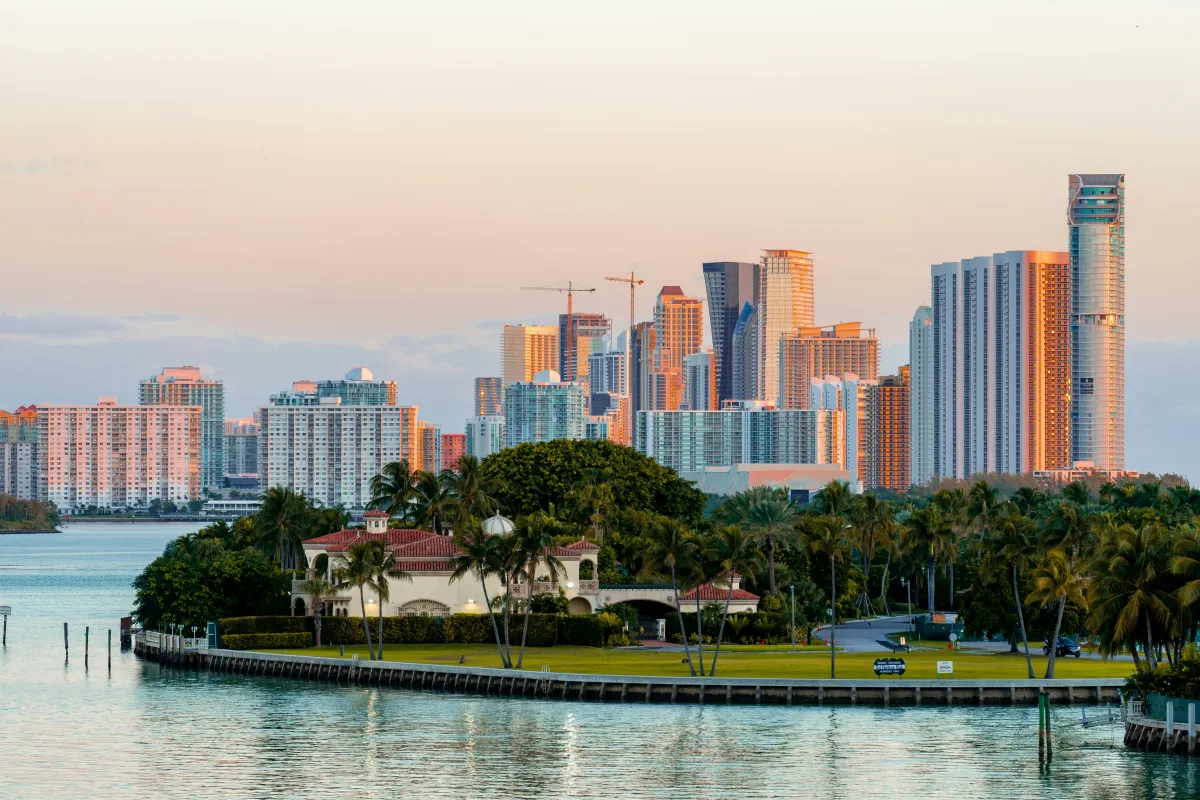
Florida has no state income tax. The cost segregation benefit shows up almost entirely on the federal return, without a separate state depreciation schedule to manage. See Your Florida Tax Savings →
- IRS Audit Techniques Guide methodology
- 40+ page CPA-ready report
- Delivered in about an hour for simple residential; 3-5 business days for properties over $3M or commercial
- Audit support included
Florida is one of the cleanest states for cost segregation because there is no state income tax. That means the benefit shows up almost entirely on your federal return, without a separate state depreciation schedule to manage. For an investor in the 37% federal bracket, every dollar of accelerated depreciation converts directly to federal savings with no state-level offset.
does cost segregation increase audit risk →

The Florida investor base skews heavily toward short-term rentals. Miami draws international and domestic tourism year-round. Orlando’s theme park corridor—Kissimmee, Champions Gate, Davenport—supports an entire vacation rental economy. The Gulf Coast from Destin to Naples is packed with seasonal STR properties. These markets all produce furnished properties with high FF&E content, which is where cost segregation captures the most value.
Florida also has a significant condo market, which creates a practical nuance: condo investors only depreciate the interior of their unit, not shared structures like the building envelope or roof. Cost segregation still works for condos—flooring, cabinetry, fixtures, and furnishings all reclassify—but the total accelerated amount is typically lower than a comparable single-family property. For condos, the study generally pencils above ~$400K. Real Example
A $750K Miami Beach Airbnb generated ~$180,000 in accelerated first-year deductions — roughly $66,600 in estimated federal tax savings.
Typical Florida savings: $22,000–$75,000
How Cost Segregation Works in Florida
Because Florida has no state income tax, the cost segregation analysis primarily affects the federal return rather than a separate state income tax filing. You file your accelerated depreciation on your federal return, and there is no Florida return to reconcile.
This has a practical advantage: there is no separate Florida depreciation schedule to maintain, and when you sell, there is no state-level recapture to calculate. Your CPA tracks one set of MACRS schedules, which simplifies both the filing and the ongoing record-keeping.
The one Florida-specific consideration worth noting is property insurance. Rising premiums have compressed cash flow for many investors in recent years. Some investors time their cost segregation study to front-load tax savings into the years when insurance costs are highest—treating the study as a cash flow offset tool, not just a long-term tax strategy. Example: $750K Miami Beach Short-Term Rental
- $750K Purchase price
- $180K Accelerated depreciation (reclassified)
- $66,600 Estimated federal tax savings (37%)
- $0 Florida state tax impact (no income tax)
Because Florida has no state income tax, the entire benefit is federal. No separate state depreciation schedule or recapture calculation. Cost segregation in Florida is most valuable for: - STR owners in Miami, Orlando, or the Gulf Coast who materially participate in their rental operation - Out-of-state investors who hold Florida rental properties and want a straightforward federal deduction - Condo investors above ~$400K looking to accelerate interior component depreciation
Most investors run a quick estimate before ordering. See your Florida numbers here.
What Investors in Florida Should Know No state income tax
The cost segregation benefit flows entirely through your federal return. There is no Florida income tax return, no state depreciation schedule, and no state-level recapture at sale. STR markets dominate
Miami, Orlando, Destin, and the Gulf Coast all produce properties with high FF&E content—the primary driver of 5-year accelerated depreciation. Furnished STRs consistently produce the highest acceleration rates. Condo basis is interior-only
Condos are common in Miami and coastal markets. You depreciate the interior only (not building shell or common areas), so the reclassified amount is lower than a comparable house. The study generally pencils above ~$400K purchase price for condos. Insurance costs affect cash flow
Florida’s rising property insurance premiums are compressing cash flow for many investors. Cost segregation can help offset this by front-loading federal tax savings into years when insurance costs are highest. Hear from a real investor
This Airbnb investor ordered a cost segregation study and used the deductions on their next tax return.
Multi-Property Investors and Form 3115 Lookback
A common Florida portfolio looks like a Miami Beach condo + a Tampa LTR + a Naples / Sarasota Gulf Coast vacation home. Properties acquired 2+ years ago without a cost segregation study qualify for Form 3115 lookback — the missed federal acceleration recaptures in a single tax year via §481(a). With Florida’s zero state income tax, every recaptured dollar flows entirely to federal. The 2020-2022 cohort of buyers who took straight-line through closing are especially strong candidates. On a 3-property FL portfolio, the catch-up federal deduction routinely runs $120K–$350K. Multi-property study bundles run 5%–15% off per property depending on count. See bundle pricing →
Key Markets in Florida
Miami, FL
International tourism and year-round demand drive some of the highest nightly rates in the country. Wynwood and Brickell condos carry heavy furnishing packages that fall into 5-year MACRS classes. The high property values ($750K+ median STR) mean the accelerated depreciation generates substantial federal savings—though condo investors should note the interior-only depreciation basis. See Miami breakdown →
Orlando, FL
Theme park proximity (Disney, Universal, SeaWorld) creates a vacation rental machine in Kissimmee and Champions Gate. These properties are purpose-built for guests: game rooms, private pools, themed bedrooms, commercial-grade appliances. The FF&E density is among the highest of any STR market, which translates directly to a larger 5-year MACRS allocation. See Orlando breakdown →
Tampa, FL
Tampa is the largest LTR-focused market in Florida — Hillsborough County’s 30-day minimum kills STR viability, but that’s the opportunity: 2020–2022 peak buyers running soft cash flow can use Form 3115 lookback to recapture 3 years of missed depreciation in one filing. South Tampa, Seminole Heights, and Riverview lead investment activity. See Tampa breakdown →

Destin, FL
The Emerald Coast draws millions of beach tourists annually, and the vacation rental market here is heavily furnished with premium finishes. Seasonal demand patterns (strong winter/spring) make it a natural candidate for investors who want to time their cost segregation study to coincide with a high-income tax year. See Destin breakdown →
Naples + Sarasota, FL
The Florida Gulf Coast — Naples, Marco Island, Bonita Springs, Sarasota, Longboat Key, Sanibel, Captiva — is the highest-quality snowbird investor market in the country. Northeast and Midwest investors hold $1.1M-$3.4M beachfront condos and SFRs as seasonal rentals, with full FF&E packages calibrated to weekly executive-family turnover. Post-Hurricane Ian rebuild documentation on Sanibel/Captiva produces some of the cleanest cost-seg outcomes in coastal Florida. See Naples + Sarasota breakdown →
Property Types That Benefit Most in Florida Vacation rentals / STRs Miami, Orlando, Gulf Coast
The primary use case in Florida. Furnished properties with pools, outdoor entertainment, and guest-ready interiors produce the highest percentage of reclassifiable components. Condos and townhomes Miami Beach, Fort Lauderdale, coastal markets
Interior-only depreciation limits the total, but cabinetry, flooring, fixtures, and furnishings still reclassify. Pencils above ~$400K purchase price. Single-family rentals Suburban Orlando, Tampa, Jacksonville
Florida’s population growth is driving SFR demand in the suburbs. Newer construction with quality finishes produces a solid reclassification profile. Multifamily Tampa, Jacksonville, Orlando metro
Florida’s population inflow supports strong multifamily fundamentals. Unit-count multiplication makes cost segregation especially efficient on 10+ unit buildings.
Have one of these property types? See what your Florida property would save.
When Cost Segregation Typically Makes Sense in Florida It typically makes sense when:
-
Purchase price above ~$350K for STRs, ~$400K+ for condos (higher threshold due to interior-only depreciation)
-
You plan to hold for 3+ years (no state recapture to worry about, but federal recapture still applies at sale)
-
Your property is furnished or you plan to furnish it — the FF&E is where most of the acceleration comes from
-
You’re a W-2 earner who materially participates in your STR (the deductions can offset your salary) It may not make sense if:
-
Condo under ~$400K — the interior-only basis may not produce enough acceleration to justify the study cost
-
You’re a passive investor with no other passive income (the deductions may carry forward unused)
-
You plan to sell within 12-18 months (recapture at 25% can eat the benefit)
Cost Segregation by City in Florida
Opportunities vary by city. Select a market below to see estimated savings and a detailed MACRS breakdown.
Miami, FL
Median STR: $750,000 · ~$38,000–$75,000 Year-1 savings · See Miami breakdown →
Orlando, FL
Median STR: $450,000 · ~$22,000–$48,000 Year-1 savings · See Orlando breakdown →
Naples + Sarasota, FL
Median Gulf Coast condo: $1,450,000 · ~$58,000–$185,000 Year-1 federal savings · See Naples + Sarasota breakdown →
Florida Cost Segregation Guides
- Cost Segregation in Miami, FL
- Cost Segregation in Orlando, FL
- Short-Term Rental Cost Segregation Condo Cost Segregation Single-Family Rental Cost Segregation Cost Segregation Calculator Bonus Depreciation Hub
See Your Estimated Florida Savings
Run your numbers in under 30 seconds. 100% bonus depreciation is available now under federal law. See Your Florida Tax Savings →
Starting at $495 for residential studies under $300K basis. Delivered in about an hour for simple residential SFR / STR; 3-5 business days for properties over $3M or commercial. Money-back guarantee.
For properties over $10M basis (large multifamily, hospitality, institutional commercial): same-day preliminary, ~2 weeks post-close final. By proposal.
How should Florida investors choose a cost segregation provider?
For a Florida investor buying a property in the $595,000 range, the choice of study provider is the single biggest controllable variable in the ROI. The methodology is fixed by IRS Audit Techniques Guide rules (industry-standard construction cost data, MACRS classification, engineering-based component reclassification) — what varies is delivery cost and turnaround time.
Traditional engineering studies often run several thousand dollars and can take several weeks, because they include on-site inspections, sales discovery calls, and scheduling overhead. The IRS Cost Segregation Audit Techniques Guide does not require a physical site visit; it requires engineering-based classification with industry-calibrated cost derivation and component-level documentation.
Modern automated providers (such as Cost Seg Smart) deliver the same IRS ATG–aligned study for $495–$1,595 in under one hour, using satellite imagery, county assessor data, and the same industry-standard construction cost databases. For a Florida investor at the metro's combined bracket, that cost delta typically exceeds the study cost itself by several times over. The CPA-Ready Guarantee (full refund if the report can't be used by your CPA) plus the 60-day money-back policy makes the decision essentially risk-free on the report itself.
The automated path is best-fit for Florida investors who: own residential STR property valued under $2M, are comfortable uploading closing docs + property photos online (no in-person visit required), and want the report in time to file the current year's return rather than the next one.
| Property value | Cost Seg Smart | Traditional firm |
|---|---|---|
| <$300K | $495 | Traditional engineering firms typically charge several thousand dollars per study, with a 4–8 week turnaround and an on-site visit. |
| $300K–$700K | $895 | |
| $700K–$1M | $995 | |
| $1M–$1.5M | $1,295 | |
| $1.5M–$2M | $1,595 | |
| $2M–$3M | $1,995 | |
| Commercial (under $1M) | $1,995 |
All Cost Seg Smart studies include the CPA-Ready Guarantee (full refund if your CPA can't use the report) plus a 60-day money-back policy. Reports are delivered in under one hour with no on-site visit required.