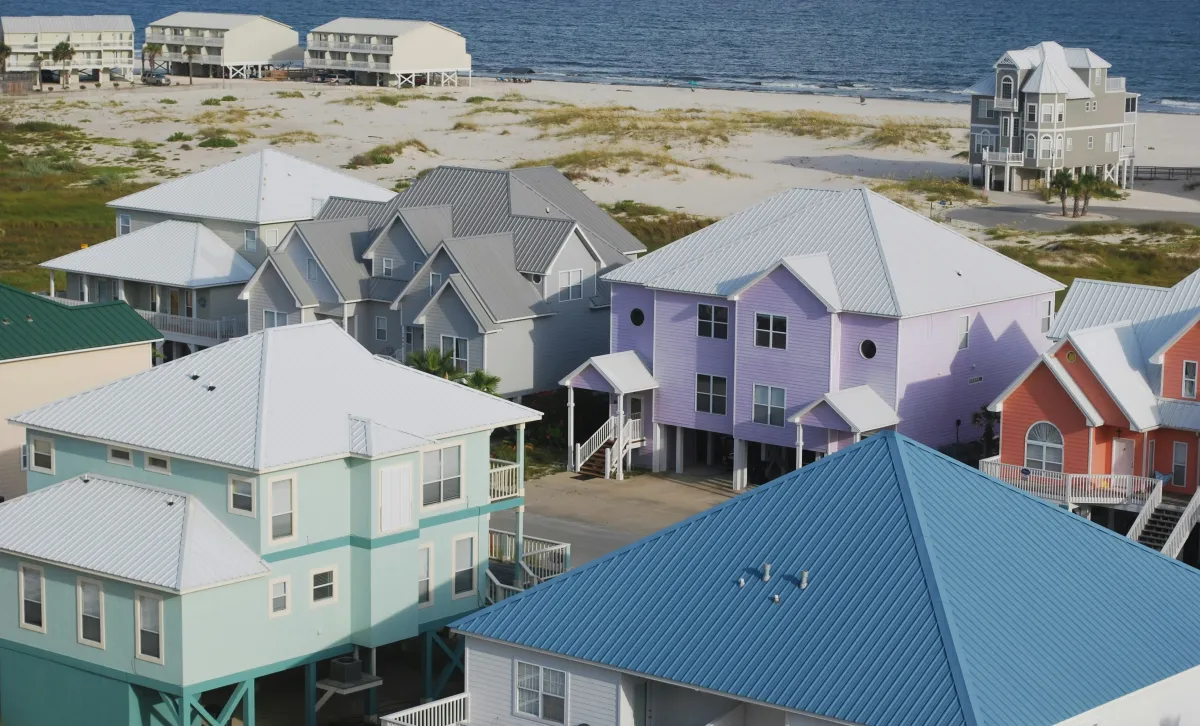
Alabama pairs strong fundamentals with favorable tax mechanics: the state generally conforms to federal bonus depreciation, so the acceleration flows on both returns. Three distinct markets drive cost-segregation demand. Huntsville, one of the fastest-growing metros in the South, runs on aerospace, defense, and Redstone Arsenal relocations that feed furnished mid-term rental demand. Birmingham anchors the state with deep, affordable single-family and small-multifamily inventory. And Gulf Shores and Orange Beach form one of the Gulf Coast’s busiest beachfront condo short-term rental markets. See Your Alabama Tax Savings →
- IRS Audit Techniques Guide methodology
- 40+ page CPA-ready report
- Delivered in about an hour for simple residential
- Audit support included, and if the IRS questions methodology we respond directly at no extra charge
- Every report passes our 16-check internal technical review and QC before delivery
At the federal level, components reclassified into 5-, 7-, and 15-year MACRS qualify for 100% bonus depreciation under §168(k), available now for property placed in service in 2026. Alabama generally conforms to the federal bonus treatment, so the same acceleration generally applies on the Alabama return. Verify the current Alabama treatment with your CPA before filing.
does cost segregation increase audit risk →
How Cost Segregation Works in Alabama
Cost segregation reclassifies portions of a property’s depreciable basis out of the slow 27.5-year (residential) or 39-year (commercial) schedule and into 5-year (FF&E, appliances, carpet, fixtures), 7-year, and 15-year (land improvements, paving, landscaping) MACRS classes. Those shorter-life components qualify for federal bonus depreciation in the year placed in service.
At the federal level, every $100K reclassified produces about $37K of Year-1 federal tax savings at the 37% bracket. Because Alabama generally conforms to §168(k), the accelerated deduction generally carries to the Alabama return as well.
Real Example, $350K Huntsville rental:
- $350,000 purchase price
- $280,000 depreciable basis (excluding land)
- $56,000 accelerated depreciation (reclassified to 5/7/15-year MACRS)
- About $20,700 estimated federal tax savings (37% bracket)
- Alabama state treatment: generally conforms (additional state-side benefit, confirm with your CPA)
Typical Alabama Year-1 federal savings: $14,000 to $52,000 depending on basis and property type.
What Investors in Alabama Should Know
Huntsville is the relocation MTR engine. Aerospace, defense, and Redstone Arsenal hiring drive a constant stream of furnished 30 to 180 day corporate housing across Huntsville, Madison, and Cummings Research Park. Furnished units with full FF&E packages reclassify at the highest rates, and Huntsville basis (often $300K to $550K for quality builds) makes the absolute first-year deductions meaningful.
Gulf Shores and Orange Beach are the beach STR play. Beachfront and near-beach condos run high-occupancy short-term rentals with heavy FF&E. Condo studies focus on interior 5-year components plus the unit’s share of building and site improvements.
Birmingham is the affordable cash-flow base. Deep SFR and small-multifamily inventory across the metro trades in the $150K to $350K range with strong rent ratios.
Conformity keeps the math simple. Because Alabama generally follows the federal bonus treatment, the state side adds benefit rather than requiring a separate add-back.
Form 3115 lookback applies. Properties acquired in 2023 or earlier without a study can claim a §481(a) catch-up of all missed depreciation in the current return.
Multi-Property Investors and Form 3115 Lookback
A common Alabama portfolio is a Huntsville furnished MTR, a Gulf Shores condo STR, and a Birmingham cash-flow SFR. Pre-2023 acquisitions without a study qualify for §481(a) lookback in a single filing. Multi-property study bundles run 5% to 15% off per property depending on count. See bundle pricing →
Key Markets in Alabama
Huntsville and Madison
The fastest-growing metro in the state, driven by aerospace, defense, and Redstone Arsenal relocations. Furnished mid-term rentals serving relocating engineers and contractors carry heavy FF&E; median furnished basis runs $300K to $550K. Estimate yours →
Gulf Shores and Orange Beach
The Gulf Coast beachfront STR market. Furnished condos and beach houses carry high FF&E density and strong seasonal occupancy. Median condo basis runs $400K to $850K. Estimate yours →
Birmingham
The state’s deepest affordable market: SFR and small multifamily across the metro in the $150K to $350K range with strong rent ratios that make cost segregation pencil even at modest basis. Estimate yours →
Property Types That Benefit Most in Alabama
Short-term and mid-term rentals, Gulf Shores, Orange Beach, Huntsville. Furnished beach condos and relocation MTRs with heavy FF&E reclassify at the highest rates.
Single-family rentals, Birmingham, Montgomery, Auburn, Mobile. Affordable basis with strong rent ratios.
Multifamily, Birmingham, Huntsville, Montgomery. Small-multifamily and value-add inventory benefits from unit-count multiplication.
Have one of these property types? See what your Alabama property would save.
When Cost Segregation Typically Makes Sense in Alabama
It typically makes sense when:
- Purchase price above ~$180K for SFR, ~$350K for a furnished beach condo or MTR
- The property is furnished or you plan to furnish it for short- or mid-term use
- You materially participate in a rental or qualify as a real estate professional
- You have passive income or W-2 income you can offset
- You hold the property 3+ years (federal recapture at 25% still applies at sale)
It may not make sense if:
- Property is under ~$130K with minimal improvements
- You’re a passive investor with no other passive income (deductions carry forward unused)
- You plan to sell within 12 to 18 months
Cost Segregation by Market in Alabama
Opportunities vary by market. Run the calculator for any Alabama property to see an estimated MACRS breakdown.
Gulf Shores and Orange Beach
Median condo STR: $560,000 · about $24,000 to $66,000 Year-1 federal savings · Estimate yours →
Huntsville and Birmingham
Median rental: $320,000 · about $14,000 to $40,000 Year-1 federal savings · Estimate yours →
Alabama Cost Segregation Guides
- Short-Term Rental Cost Segregation
- Single-Family Rental Cost Segregation
- Multifamily Cost Segregation
- Cost Segregation Calculator
- Bonus Depreciation Hub
- See a sample cost segregation report
- Our methodology and 16-check QC process
- Short-term rental material participation test
See Your Estimated Alabama Savings
Run your numbers in under 30 seconds. 100% bonus depreciation is available now under federal law, and Alabama generally conforms. Confirm state-side treatment with your CPA. See Your Alabama Tax Savings →
Starting at $495 for residential studies under $300K basis. Delivered in about an hour for simple residential SFR / STR; 3-5 business days for properties over $3M or commercial. Money-back guarantee.
For properties over $10M basis (large multifamily, hospitality, institutional commercial): same-day preliminary, about 2 weeks post-close final. By proposal.
How should Alabama investors choose a cost segregation provider?
For a Alabama investor buying a property in the $350,000 range, the choice of study provider is the single biggest controllable variable in the ROI. The methodology is fixed by IRS Audit Techniques Guide rules (industry-standard construction cost data, MACRS classification, engineering-based component reclassification) — what varies is delivery cost and turnaround time.
Traditional engineering studies often run several thousand dollars and can take several weeks, because they include on-site inspections, sales discovery calls, and scheduling overhead. The IRS Cost Segregation Audit Techniques Guide does not require a physical site visit; it requires engineering-based classification with industry-calibrated cost derivation and component-level documentation.
Modern automated providers (such as Cost Seg Smart) deliver the same IRS ATG–aligned study for $495–$1,595 in under one hour, using satellite imagery, county assessor data, and the same industry-standard construction cost databases. For a Alabama investor at the metro's combined bracket, that cost delta typically exceeds the study cost itself by several times over. The CPA-Ready Guarantee (full refund if the report can't be used by your CPA) plus the 60-day money-back policy makes the decision essentially risk-free on the report itself.
The automated path is best-fit for Alabama investors who: own residential STR property valued under $2M, are comfortable uploading closing docs + property photos online (no in-person visit required), and want the report in time to file the current year's return rather than the next one.
| Property value | Cost Seg Smart | Traditional firm |
|---|---|---|
| <$300K | $495 | Traditional engineering firms typically charge several thousand dollars per study, with a 4–8 week turnaround and an on-site visit. |
| $300K–$700K | $895 | |
| $700K–$1M | $995 | |
| $1M–$1.5M | $1,295 | |
| $1.5M–$2M | $1,595 | |
| $2M–$3M | $1,995 | |
| Commercial (under $1M) | $1,995 |
All Cost Seg Smart studies include the CPA-Ready Guarantee (full refund if your CPA can't use the report) plus a 60-day money-back policy. Reports are delivered in under one hour with no on-site visit required.